
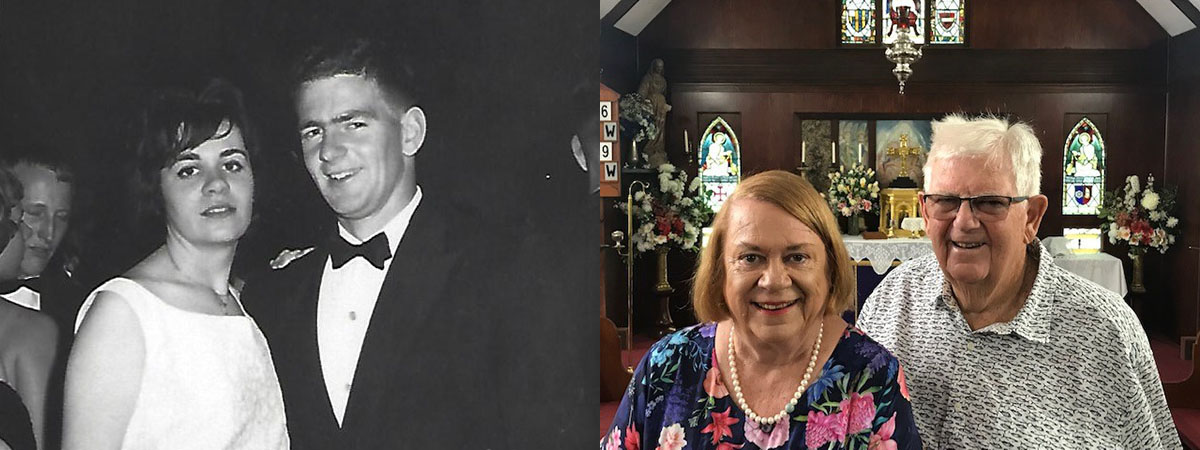
We met at UNE - Adrienne Spence and Ralph van Gelder
Future teacher Adrienne Spence and Bachelor of Rural Science student Ralph van Gelder have a friend and a last-minute invitation to thank for their match.
“I hadn’t planned on going to my graduation ball … my family were not all that well off,” says Adrienne, now 83. “I’m also very tall and told my friend I was sick of having to wear flat-heeled shoes because all the men were shorter. She was studying Science and was going to ask Ralph to go with her but said she would find someone else so he could take me. The Science faculty was full of men, while men were scarce in the Arts faculty – and particularly tall men.”
Ralph, now 86, measured up nicely at 181 centimetres in height.
“I ended up being the cast-off but didn’t do too badly in the end,” he says.
The pair were married in 1965, had two children and enjoyed fulfilling careers – Adrienne teaching in state and independent schools and Ralph as a private agribusiness consultant and educator. But they still recall their time at UNE fondly.
“We both started in 1959, but the academic year was delayed for six weeks after fire destroyed the Belshaw building and they had to build new science blocks,” says Adrienne. “Mary White, in those days, consisted of three blocks and we ate in the Booloominbah dining hall. My Latin lectures were held upstairs in the old music room.”
“I was only at UNE for six weeks before a mate and his grandfather were killed in an accident and I left to help the family out on their property,” says Ralph. “I ended up being away for 18 months and returned in 1961, to live in the Robb College townhouse Kendall. The university was very supportive.”
Adrienne remembers the Warden of Women and later Mary White Principal Mary Bagnall as “something of a mother hen” who set up a magazine and social committees for students in each of the blocks and encouraged the creation of an overseas students committee to host concerts and dinners.
“UNE was so small when we started,” she says. “It didn’t matter what faculty you were in, we all mingled. We were very close, like brothers and sisters. Our lecturers demanded high-quality work, but it was good fun, and I worked as a waitress in the dining halls to earn a little extra money. Very few people had vehicles, and it cost a shilling to catch the bus into town.”
On a NSW Department of Education teacher’s scholarship, Adrienne was luckier than some. “I got a big book allowance … many other students struggled to afford books and things.”
“there were no paths, and you often had to walk through mud to get up the hill to Booloominbah”
Although facilities were basic – “there were no paths, and you often had to walk through mud to get up the hill to Booloominbah” – Ralph recalls strong camaraderie among students and lecturers.
“Some of the professors knew just about every student on campus,” he says. “They were dedicated and interacted a lot with us,” adds Adrienne. “You didn’t just see them in the lecture theatre. They socialized with us to a certain extent, too.”
Not being a “terribly good student”, Ralph says he had to devote a lot of time to his studies but would catch up with Adrienne on a Saturday night. She played hockey and Ralph cricket, soccer and rugby, including scoring the try that won Robb its first rugby premiership, in 1962.
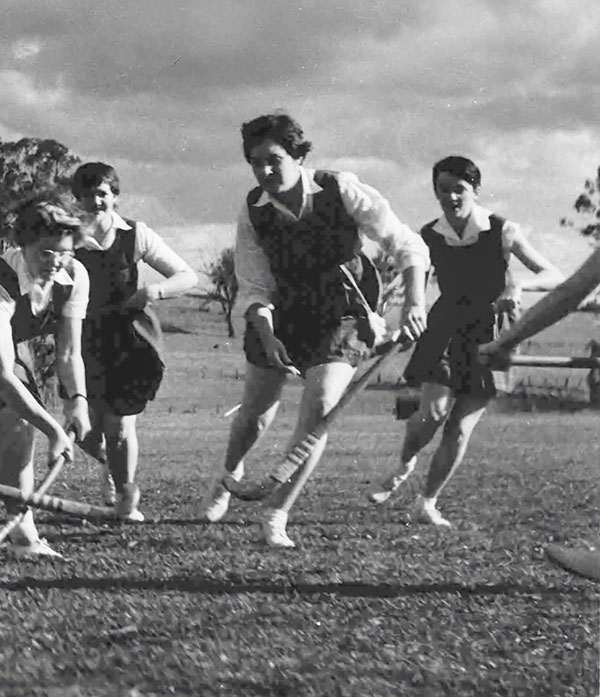 Adrienne Spence playing hockey at UNE
“I saw a lot more of Ralph’s friends, who would help me to carry these great heavy tomes I retrieved from the bowels of the library archives for my Diploma of Education dissertation,” Adrienne says. “So, he was very useful to me, even though I might not have seen a lot of him.”
After graduation, the pair lived in South Australia and across NSW as they developed their professional lives. Ralph’s career took him to Mongolia, northern China, North Korea, Kyrgyzstan, Kazakhstan and India, where he helped to develop the cashmere industry and contributed to science, education and marketing across meat and pastoral industries in collaboration with the likes of AusAID, the United Nations Development Programme and World Bank. He also worked, for a time, as a lecturer in sheep and pasture management at the Orange Agricultural College.
As well as teaching, Adrienne became involved in, and president of the NSW/ACT Independent Education Union, to address the inequality women experienced, and was one of the first female presidents of a Trades and Labor Council in Australia (in Orange, NSW).
The couple now live north of Brisbane.


