
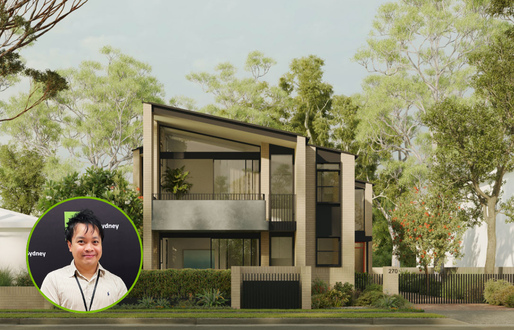
Earlier this year, the NSW Government released a Housing Pattern Book of pre‑approved, architect‑designed homes for the “missing middle”, available for just $1 per design. The aim is to speed up quality medium‑density housing in the hopes of solving Australia’s housing crisis.
But can the initiative achieve its goals, and what are the trade-offs? We spoke with Dr Isara Khanjanasthiti, Lecturer in Urban and Regional Planning at the University of New England, to find out.
What is the NSW Government Housing Pattern Book and who is it for?
The Housing Pattern Book is a recently published guide from the NSW Government containing eight housing designs to suit various sites. The pre-approved, architect-designed housing templates cover a range of dwellings, including semi-detached homes to terraces, row and even manor homes. These types of housing — also known as the ‘missing middle’ in Australian housing typology — sit between single, detached homes and high-rise apartment towers.
This initiative shifts the housing conversation from reactive approvals to proactive design.
The book is designed for councils, developers, and community housing providers — but also for everyday people who want to build smarter. It fills a gap between high-end custom architecture and mass-market volume builds, the latter of which have become increasingly common in recent years.
Why do we need the Housing Pattern Book?
NSW — like the rest of Australia — is facing a housing crisis. Affordability, supply and quality all need attention. This scheme tackles all three dimensions at once.
Importantly, the designs in the book come with a new fast-track development approval pathway — helping deliver high-quality housing quickly that’s actually liveable, sustainable, and suited to NSW’s climate and communities.
Each design considers lot size, orientation, climate and materials. There’s also a strong emphasis on passive design — natural light, airflow, insulation — and every home meets or exceeds BASIX and NatHERS energy ratings. These ratings are related to sustainability design features.
The designs presented in the book are not just about aesthetics; they’re about performance and adaptability.
Do you think this will help Australia’s housing crisis?
Low- and medium-rise homes could be one of the key solutions to Australia’s housing crisis, but, like most other initiatives, it’s not a silver bullet; it’s a smart tool in the kit.
Importantly, these homes are less obtrusive in terms of affecting the existing ‘feel’ or characteristics of a neighbourhood, especially when compared to high-density developments like high-rise apartments. Also, by streamlining planning approvals and lifting design quality, the Pattern Book can help deliver more homes, faster — and better ones too. However, we still need broader, systemic reforms around land use, infrastructure and affordability. The Pattern Book helps with supply and liveability, but it won’t fix housing affordability on its own.
The Pattern Book helps with supply and liveability, but it won’t fix housing affordability on its own.
Additionally, the Pattern Book is targeted at lots that are earmarked for infill or medium-density development. This makes it highly suitable for urban areas of NSW, particularly where affordability is a concern — think Sydney!
However, the book may not be as applicable in regional and remote communities.
Therefore, in future housing initiatives by the NSW or Federal Government, I would like to see more targeted efforts to improve housing affordability and liveability in regional and remote NSW.
I also urge the NSW Government to prioritise the delivery of essential infrastructure like schools, hospitals, and public transport in new and emerging housing suburbs throughout the state.
Where do you think the designs shine and fall short — will they all look alike on the street?
The Pattern Book isn’t about uniformity — it’s about flexibility. Each design can be adapted to suit different sites and communities. The goal is to raise the baseline, not flatten diversity. It should encourage more thoughtful design variation than what we see in many volume-built estates today.
I appreciate the emphasis on natural light and ventilation — living areas that face north, windows on two sides, and ceiling fans as standard. That’s a well-thought-out design.
Nevertheless, I’m less sold on some of the external aesthetics of the designs. They lean minimalist, which may not suit every homebuyer’s taste or complement a neighbourhood’s existing ‘feel’. Overall, they’re well-considered, particularly in terms of sustainability and spatial efficiency.
If people are interested in planning and want to shape our housing and neighbourhoods, what can they do?
Urban and regional planning could be an incredibly exciting career pathway for you! At UNE, we offer the following tertiary courses accredited by the Planning Institute Australia:
- Bachelor of Urban and Regional Planning;
- Graduate Diploma in Urban and Regional Planning; and
- Master of Urban and Regional Planning.
We also offer a Diploma in Town Planning. All of our courses can be undertaken online with flexible pacing—perfect for the busy adults juggling various responsibilities! We also consistently earn 5-star ratings for student support and experience.


