
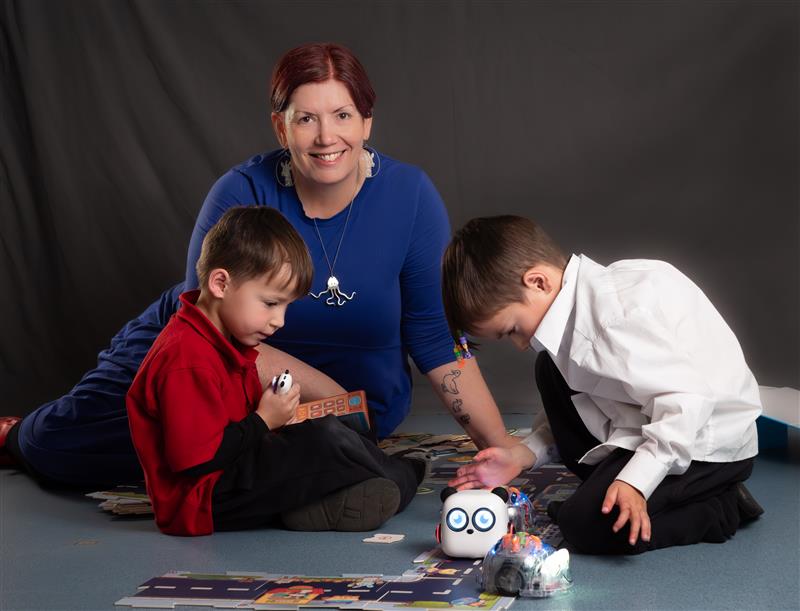
From iPads to robots, Jo Bird’s research over the past decade has charted the rapid deployment of technology in children’s play – and the ethical dilemmas that presents for parents and educators.
“This is a research minefield,” says Jo, a lecturer in Early Childhood. “We are a digital society. We are widely embracing Artificial Intelligence at the same time as we are scrutinising children’s screen time and imposing social media bans on teenagers.
“Children are witnessing the adults in their lives using technologies and the value they place on these devices. However, many early childhood and primary school educators are still reluctant to incorporate technologies into their classrooms, fearing it will limit children’s creativity and imagination.”
Jo’s research has posed some uncomfortable questions around when and how to introduce technologies, STEM (integrated science, technology, engineering and mathematics) concepts and even robots to littlies as young as three. From her initial UNE PhD research – which explored the use of working and imaginative technology in play and learning in preschools – it has grown to consider the merits of children learning coding and how STEM can help build their resilience to withstand life changes.
Rather than hamper a child’s development, Jo has found that technology employed thoughtfully can enhance their skills.
“Our Preschoolers Can Code project concluded that technology encouraged children to share and work together to solve problems,” Jo says. “With robots, it can be a productive thing to fail, because you learn from mistakes, and it improves your problem-solving; there’s questioning and hypothesising.
“And all this at a time when preschoolers want to make more decisions for themselves and are pushing back against rules. With a robot, they can make it do what they want, but also learn teamwork and communication skills along the way.”
Now, Jo is investigating how STEM activities might bolster confidence and ease the transition from preschool to primary school and year 6 to high school. “We hope these activities might support school readiness by building academic skills and self-esteem through shared experiences across these stages,” Jo says. “We are interested to see if they boost social and emotional connections and leadership, and whether our program might enhance collaboration between educators. It’s all about helping to produce school-ready students and student-ready schools.”
A pioneer of investigating technology use among children, Jo has also been instrumental in integrating STEM’s use into the teaching of future early childhood educators.
“Our teaching of UNE early childhood students reflects the latest evidence in terms of the value of introducing technology to children at a young age,” she says. “In the past, early childhood educators often haven’t had any professional training in this field as part of their undergraduate degree and haven’t known how to introduce technology to young children.”
Importantly, Jo’s research is providing clues as to how our society might address issues around ethical digital citizenship and responsible behaviour, in alignment with recommendations from Early Childhood Australia and the eSafety Commissioner.
“Children will use technology, and they need to learn how to use it appropriately,” Jo says. “I hope our research will inform guidelines for the provision and use of technology among children, to help reduce some of the discomfort educators and parents feel and provide a scaffold for learning.
“With two young children of my own, I understand how hard it is to navigate technology use. I work a lot with my boys to teach them how to decide and discern whether something is appropriate or not, and the privacy and security issues involved.
“By being prepared and informed, parents and educators alike can explore the full potential of technology as an effective learning tool.”
Invitation: Jo’s team is seeking funding, and preschool and school partners keen to trial its STEM initiative for their transition practices, contribute to resources and co-develop supporting professional documentation.
For more information: jbird21@une.edu.au


