
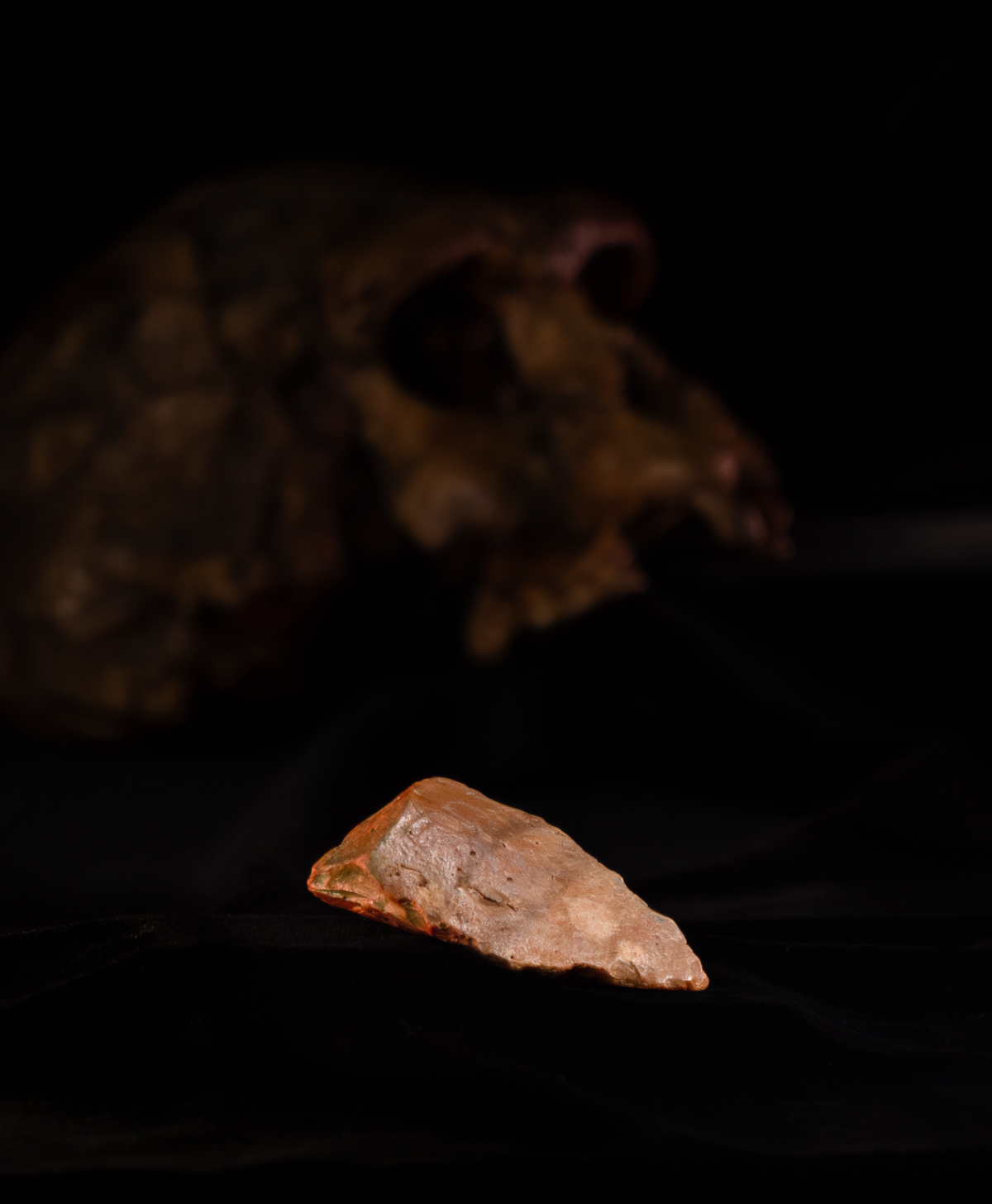
UNE expert in stone tools, Professor Mark Moore, pictured below, contributed to an important study published today in Nature that uncovers the earliest evidence of archaic human relatives moving across the sea.
Moore, a UNE Professor of Archaeology and Palaeoanthropology, is part of an international team that investigated seven stone tool flakes found on the Indonesian island of Sulawesi. The flakes indicate that hominins lived on Sulawesi at least 1.04 million years ago (mya), and possibly 1.48 mya, pre-dating the earliest evidence of modern human occupation on the island by nearly a million years.
The finding revises understanding of archaic hominins' ability to cross ocean straits, and of their spread through the oceanic island zone now largely represented by modern Indonesia and the Philippines.
 The multi-author study is published in the prestigious journal Nature under this link: (https://doi.org/10.1038/s41586-025-09348-6)
The work was built around flakes of chert (silicified limestone) found with other animal fossils at a site in southern Sulawesi. (3D scans of these artefacts can be viewed online at https://une.pedestal3d.com/r/ZdPcP-kXvc/)
Unremarkable to most viewers, to Moore these pieces of rock show unmistakeable signs of being flaked from a larger piece of rock by an intelligence that had an end in mind.
"To get a nice flake with long, sharp edges, you have to strike the parent rock at just the right angle so that it cracks open, rather than shatters," Moore says.
"You can get sharp-edged flakes by just smashing stones together and shattering them, but you then get a lot of random pieces and only get a flake that can be used as a tool through luck."
"The nature of the flakes found by the team in Sulawesi show that these hominins were technically more sophisticated than that. They knew what sort of rocks they needed, and understood how to reliably strike flakes from them. They were not just bashing rocks together."
From a distance of a million years, Moore says it is impossible to say exactly how the flakes were used by their hominin makers, but it is probable that they were used as cutters and scrapers in food production.
For Moore, the work adds another piece of information to the puzzles that confront palaeoanthropology, which remain intriguingly unresolved.
The Sulawesi study adds a new dimension to a question that has been long debated: how did hominins spread out of the Asian mainland and across the archipelago now largely represented by Indonesia and the Philippines?
Until the Sulawesi find, the earliest evidence of hominin occupation in the archipeligo came from 1.02 mya stone tools found on the island of Flores, 300 km to the south of Sulawesi.
Moore was part of the team that in the early 2000s excited the scientific community with the discovery of the Flores tools and more especially, fossils of the tools' possible maker, the small hominin Homo floresiensis. Standing not much more than a metre high, H. floresiensis was dubbed 'the hobbit'.
The Flores discoveries showed that archaic hominins dispersing off the Asian mainland were capable of crossing at least 24 kilometres of sea, the estimated width of the strait separating Flores from its western neighbour during a period of lower sea levels.
The Sulawesi findings add a new dimension to hominin sea travel. Not only are the Sulawesi stone tools older than their Flores counterparts, but Sulawesi is separated from Flores and the island chain by 300 kilometres of ocean.
Moore is personally interested in the broader question of whether hominin populations were changed by their technologies, or whether technology took a back seat to natural selection.
Following the Flores discoveries, fossils of another apparently small hominin, Homo luzonensis, were found in the Philippines.
“It’s a developing picture,” Moore says.
“We are learning that the archipelago and the adjacent mainland were populated by these groups of early hominins, and that their bodies underwent radical adaptation to their environments.”
“They retained their essential technological adaptation to the environment, but the technologies were not powerful enough to hold natural selection at bay.”
And, Moore reflects, the vast stretches of time between our enquiries and these archaic toolmakers continue to obscure a lot of understanding.
“We really know very little about the history of these populations. How did they manage to adapt to such diverse landscape and ecologies, and how long did they survive in these pockets?”

