Campus Farms
The Campus Farms are 385 hectares in total and encompass Laureldale, Trevenna, Maxwellton, Tombs and Clark's Farm.
Main Areas of Research
- Agronomy and Soil Science Research
- Undergraduate Teaching
- Commercial Pasture Technology Site
- Sheep Grazing
- Feed additives for reducing methane emissions in sheep
- Solar
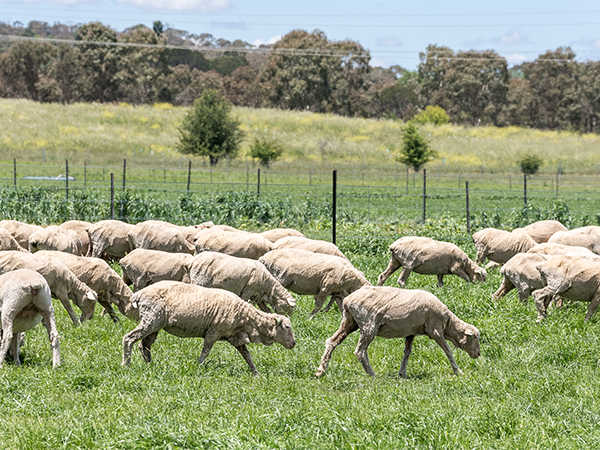
Teaching and Community Recreation Main Areas of Research Infrastructure on Trevenna Located just a short walk from the agriculture precinct and glasshouses, Trevenna provides an ideal location for small scale agronomic and sheep production research and teaching. With small plots fenced to exclude livestock, native animals such as kangaroos and pests such as rabbits, this property allows for undergraduate crop competitions and small crop experiments. Soil pits have also been excavated for soils teaching. Insect traps are also deployed on this property for entomological collection for teaching and research. In conjunction with Maxwellton, sheep research projects related to grazing management, wool production, parasite management and lambing are conducted. A major proportion of Trevenna is a pine forest planted as a commercial forest lot. This forest is now home to a mountain bike track used by the Armidale community. Undergraduate Teaching Main Areas of Research Infrastructure on Clark's Farm Used to support undergraduate teaching, Clark’s Farm provides a real-world field site to study drought resilience, best practice grazing methods and soils. Joining the main UNE campus on the eastern side, Clark’s Farm is predominately used to support undergraduate teaching by providing a real-world field site to undertake sheep production, pastures and soils practicals within the context of a commercial sheep property. With a range of soil types across the property, Clarke’s has excavated soil pits to illustrate the different types and the different horizons throughout the soil profile. Clark's Farm is used extensively to host school and industry groups visiting UNE. Livestock Behaviour and Production Main Areas of Research Infrastructure on Maxwellton Located just a short walk from the campus, Maxwellton provides an ideal location for livestock production research and teaching. Maxwellton lies immediately to the west of the UNE campus, is watered by Dumaresq and Pipeclay Creeks and encompasses a range of soil types. Split into a number of smaller paddocks this property is used for sheep production, parasitology, reproduction and grazing research and teaching. With a range of topography across the paddocks, Maxwellton provides variation in feed and shelter availability. The proximity of this property to the main UNE campus also makes it ideal for student research. Maxwellton is used to collect data underpinning the development of biophysical models of livestock production, health and methane emissions. Main Areas of Research Infrastructure on Tombs Connecting with industry the pasture technology site is used to evaluate the performance of a range of pasture and forage crop varieties. The Tombs UNE block is currently leased by DLF Seeds for evaluating forage plant genetic performance and to undertake agronomic trials in the New England. DLF Seeds is involved in a wide range of research to assist agronomists, farmers and rural retailers achieve a greater understanding of pastures and crops, improving productivity and profitability on-farm. Their network of research facilities allows them to breed and evaluate new products under animal grazing, prior to commercial release. This helps ensure each cultivar delivers the production gains anticipated and is safe for animal systems. Approximately, 200 trials are conducted annually at over 15 trial sites (one of which is Tombs) throughout the country, making it the largest replicated pasture trial programme in Australia. Some of the key species currently being evaluated at Tombs include Cocksfoot, White Clover, Annual, Italian and Perennial Ryegrass, Continental Tall Fescue, and novel endophytes. Intensive animal systems Main Areas of Research Infrastructure on Laureldale Located adjacent to the main UNE campus Laureldale is used for evaluation of crops and pastures, sheep parasitology and low emissions sheep production. Long-term agronomy plots are used for crop and pasture research including assessing wheat varieties for genes that confer resistance to the Barley Yellow Dwarf virus. Internal nematode parasites of sheep are the largest animal health cost to the Australian sheep industry. Plots are used to study the epidemiology of infection particularly to characterise the ecology of major parasites and the host response to infection.Farms
32 haDescription
56 haDescription
111 haDescription
 Pasture Technology Field Site
38 haDescription
148 haDescription