
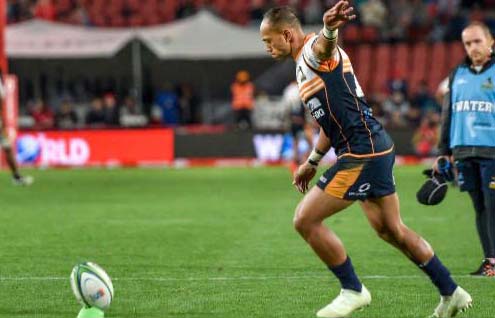
It’s 2016, the Super Rugby season has just wrapped up, and Christian Leali’ifano has quickly climbed the ranks of the Australian rugby scene to become one of the game's most respected figures. Then, out of nowhere, his career comes crumbling down after a shock leukemia diagnosis.
Five years later, he’s fully recovered, and has re-established himself as one of the greats of the game. While it may seem like a miracle recovery to outside onlookers, his return to rugby is largely thanks to science.
With a background in occupational therapy, human movement, stress and behaviour, UNE’s Dr Ben Serpell was a key player in Leali'ifano’s comeback.
He says by putting his knowledge of human behaviour and performance into action, he was able to help take Leali’ifano’s career to new heights.
“I’d developed a sound scientific knowledge base which enabled me to think outside the box and apply different principles of human performance to not only improve his health, but also enhance his rugby performance which led to the incredible feat of him becoming the Wallabies vice-captain for the last world cup," he says.
“I was proud I could help him return to sport and have an even greater impact than prior to his diagnosis," says Dr Serpell.
Whether you’re an athlete or a tactical police officer, our basic human response can be the same.
Dr Serpell says applying science in this way is key to improving the performance of not just athletes, but high achievers in a range of fields. This is an area he and UNE Professor in Biomedical Science Christian Cook have been researching together for the past five years.
"Whether you’re an athlete or a tactical police officer, our basic human response can be the same," he says.
“We actually see similar physiological and behavioural responses amongst high achievers across many domains, and what excites me is using this to help people thrive, and not just survive."
Dr Serpell says understanding the links between behaviour and performance can lead to top results, and it’s something he experienced first-hand when working with Brumbies Rugby in 2016.
“We were short odds to win the Super Rugby title at the start of the season, and while we were fit, we did not have ‘buy in’ from the players, and overall we underperformed," he says.
“In 2017 I engaged Professor Christian Cook via his role at the Australian Institute of Sport to conduct some behavioural research which lead to us enhancing team culture by adjusting some basic physiological markers.
“That year we were tipped to be wooden spooners because we’d lost so much talent from the previous year, yet, through that work of influencing human behaviour across the team we ended up becoming the strong Australian Super Rugby franchise.”
The days of going by gut feel have gone. It’ll take six to eight years to become an Olympic gold medallist – ‘gut feel’ will not work for that long.
Over his career, Dr Serpell has worked with teams including the Wallabies, the NSW Waratahs and the Brumbies, as well as athletes like Australian cricketer Ellyse Perry.
As for how he’s helped them achieve so much, he says implementing science into their training has been a pivotal factor.
"Don’t get me wrong, some intuition is important, but you can’t just say these days, 'I think if they’re to run this many kilometres they’re likely to get fitter and perform well'," he says.
“The days of going by gut feel have gone.
"It’ll take six to eight years to become an Olympic gold medallist – implementing training techniques based on ‘gut feel’ will not work for that long."
You can read more about Dr Serpell’s work via his Research Gate profile.


